


Quercetin and Resveratrol: Their Health Benefits and Role in Combating Ageing
In recent years, the field of healthy ageing research has seen growing scientific interest in a number of natural compounds with promising biological properties. Among the most notable of these are quercetin and resveratrol, which have featured prominently in a large number of recent studies due to their potential link to supporting cellular health and enhancing bodily functions as we age.
In this article, we review what science has to say about these two compounds, their mechanisms of action at the cellular level, their most significant documented health benefits, and how they can be utilised as part of a holistic health regime.
What is quercetin? Sources and structure
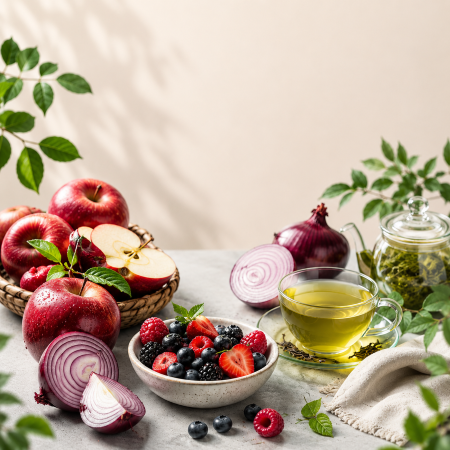
Quercetin is a plant flavonoid belonging to the flavonol class, and is one of the most widespread polyphenols in the plant kingdom. It is found in significant concentrations in onions (particularly red onions), apples, grapes, capers, green tea, broccoli and cranberries. According to a comprehensive scientific review published in Phytotherapy Research in 2025, which examined the scientific literature published in PubMed, Scopus and Web of Science up to March 2025, quercetin is classified as a multi-target biological compound that acts via interconnected molecular and cellular pathways affecting the ageing process and associated chronic diseases.
What is resveratrol? Sources and composition
Resveratrol is a polyphenolic compound belonging to the stilbene family, produced by plants in response to environmental stresses such as fungal infections and ultraviolet radiation. Resveratrol is found primarily in the skins of red grapes, red wine, berries, cocoa beans and the roots of Japanese knotweed, which is considered the source with the highest concentration. A comprehensive scientific review published in MedComm in 2025 confirmed that resveratrol has attracted widespread scientific interest due to its anti-inflammatory, antioxidant and anti-ageing properties, reviewing the latest evidence on its molecular mechanisms, clinical efficacy and safety profile across a diverse spectrum of diseases.
Cellular mechanisms: How do they work at the genetic and cellular levels?
Quercetin — four main pathways
- Activation of the Nrf2 pathway: Quercetin stimulates the nuclear protein Nrf2, which regulates the gene expression of endogenous antioxidant enzymes such as SOD, catalase and heme oxygenase-1, thereby reducing free radicals at the cellular level.
- Inhibition of the NF-κB pathway: This pathway is responsible for low-grade chronic inflammation associated with ageing, heart disease and diabetes. Quercetin inhibits this pathway and reduces inflammatory cytokines such as TNF-α and IL-1β.
- Activation of SIRT6: A study published in *Exploration of Drug Science* in 2025 linked quercetin to the activation of the SIRT6 enzyme—one of the sirtuin proteins associated with DNA repair and cellular longevity—through its binding to a specific enzymatic inhibition site.
- Senolytic property: Quercetin, particularly when combined with dasatinib, has the ability to target senescent cells and induce their programmed cell death. This is being investigated in a clinical trial registered on ClinicalTrials.gov to assess its effect on the epigenetic ageing rate in healthy humans.
Resveratrol — the mitochondrial and genetic pathways
Resveratrol works primarily by activating SIRT1 (Sirtuin 1), an enzyme known as the ‘youth gene’ due to its role in regulating gene expression and enhancing mitochondrial function and the efficiency of cellular energy production. It also activates the AMPK pathway, which mimics the effects of calorie restriction at the cellular level.
Health benefits backed by scientific research
1. Combating cellular ageing and extending healthy life expectancy
A review published in the Journal of Aging Research in 2025 concluded that quercetin and resveratrol are among the most prominent natural compounds studied in the US National Institute on Ageing’s Therapeutic Interventions Testing Programme, thanks to their promising results in in vitro models. Studies have shown that quercetin increases organisms’ resistance to oxidative stress and prolongs their lifespan in multiple models
2. Supporting cardiovascular health
Quercetin helps to inhibit LDL oxidation and improve vascular elasticity through its effect on the cellular oxidation pathway. Resveratrol, meanwhile, has been linked to improved vascular endothelial function and reduced inflammation in blood vessel walls, as documented in a PMC review (2025) that examined recent evidence on the role of resveratrol in age-related diseases.
3. Neuroprotection and support for cognitive health
A review in Phytotherapy Research (2025) indicated that quercetin modulates neuroinflammatory pathways and reduces the accumulation of misfolded proteins in the brain associated with dementia and Alzheimer’s disease, whilst also protecting neurons from death caused by oxidative stress. Resveratrol, meanwhile, activates SIRT1 in nerve cells, thereby enhancing neural plasticity and supporting memory and concentration.
4. Supporting immunity and alleviating chronic inflammation
Both compounds inhibit the NF-κB pathway and reduce chronic low-grade inflammation (inflammaging), the inflammatory process associated with aging which is considered one of the main drivers of heart disease, diabetes and osteoporosis.
5. Supporting eye health
A systematic review published in PMC in 2025, specialising in eye diseases in older people, concluded that quercetin targets three concurrent pathways in photoreceptor cells: cellular ageing, oxidative stress and inflammation — the three main factors associated with age-related eye diseases such as macular degeneration.
6. Supporting metabolic health
Quercetin is associated with improved insulin sensitivity and reduced levels of blood sugar and ‘bad’ cholesterol, making it particularly important for those with markers of metabolic syndrome.
Dietary sources of quercetin and resveratrol
| Food source | Main compound | Note |
| Red onions | Quercetin | One of the most concentrated sources |
| Apples (with skin) | Quercetin | A significant amount is lost during peeling |
| Caper berries | Quercetin | The highest known dietary source |
| Red grape skins | Resveratrol | Concentrated in the peel, not the flesh |
| Blueberries and redberries | Both compounds | A rich and varied source |
| Green tea | Quercetin + EGCG | Synergistic effects with other antioxidants |
| Japanese sorrel root | Resveratrol | The most concentrated source amongst supplements |
Summary
Quercetin and resveratrol are at the forefront of a new generation of natural compounds that act at the genetic and cellular levels, rather than merely having superficial effects. With mounting scientific evidence supporting their role in delaying cellular ageing and promoting heart, brain and metabolic health, they are taking a leading position on the list of the most studied and important health supplements for 2025–2026.


